Interesting facts about Rome’s oldest stadium and the greatest and largest Stadium in mankind history – the “Circus Maximus”.
1. The largest stadium in ancient Rome
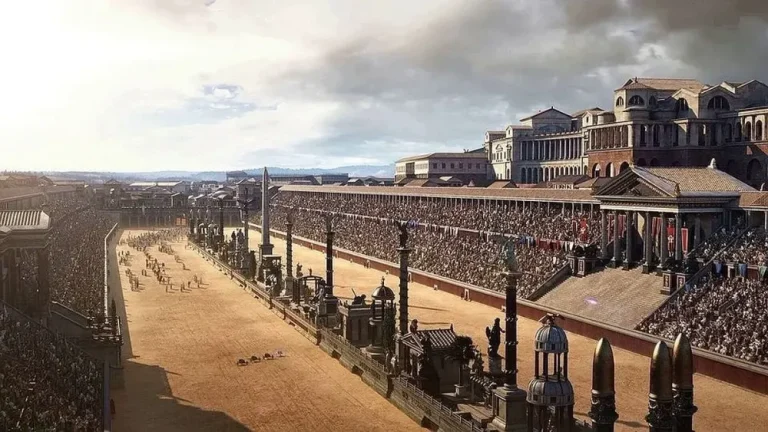
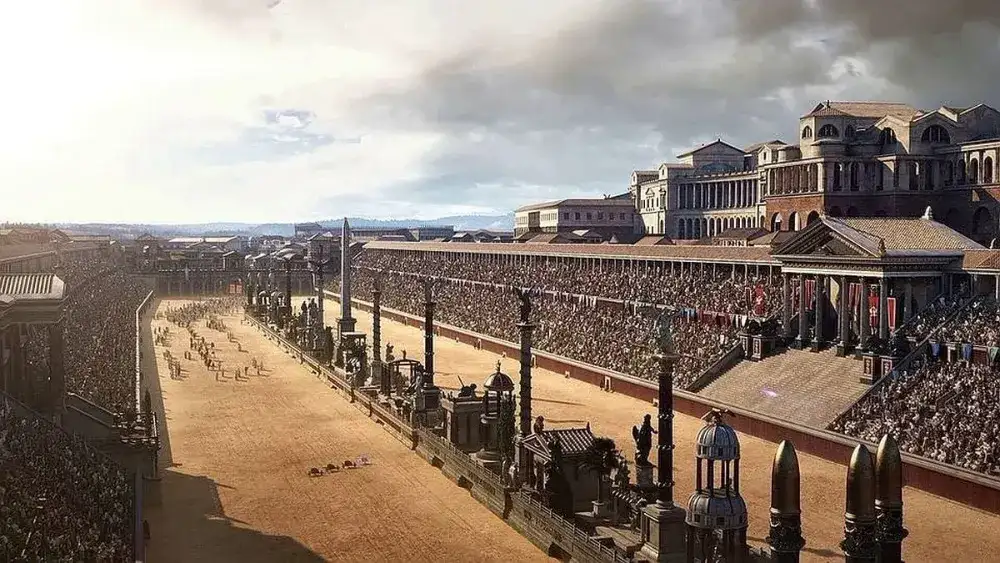
The Circus Maximus is considered the largest stadium in ancient Rome and the first stadium built by the Romans. It was designed for chariot races (ludi cercenses), but also other events were held there including gladiatorial combats (ludi gladiatorii) and animal hunts, some of which were exotically spectacular in the extreme, such as when Pompey organized a contest between a group of barbarian gladiators and 20 elephants. The popular chariot races were held here for almost a millennium.
2. Seating three storeys high
It was first constructed in 6 century BC. and various improvements were made to the design of this massive arena. The stadium was surrounded with rows of seats all around, 3 stories high. The lowest were made of concrete and stone and wood for the rest. The lower part of the seating area was built in marble. Shops outside the circus would have served the needs of the spectators. ). A decorated barrier (spina or euripus) ran down the centre of the track, so that chariots ran in a circuit around conical turning posts (metae) placed at each end. The spina also had two obelisks added over the centuries, one in the centre and one at the end.
3. Its obelisks now stand in other squares
First excavations were during the papacy of Sixtus ˅ in 1587 and the two obelisks of the spina were recovered. Nowadays they can be seen in Piazza del Popolo and Piazza S. Giovanni in Laterano.At its largest during the 1st century CE following its rebuilding after the fire of 64 CE, this large arena with length at 621m.(2,037ft.) and width at 118m.(387ft.) had a capacity for more than 250,000 people (one quarter of Rome’s population at that time).The spectators were seated on banks 30m. wide and 28m. high.
4. Between the Palatine and Aventine hills
The Circus is situated between the Palatine and the Aventine hills. Due to the fact that the Palatine Hill was the home of the royal families and the Emperor, an imperial box was built high up for them in the palace area on the hill. Private boxes were made also for politicians, important military personnel and senators. Admission to the Circus Maximus was free and all levels of Roman society, from the emperor to the urban poor, came to see the chariot races.
5. Light, colour-coded racing chariots
Chariots were very light, probably made of leather, so they could go as fast as possible. It would have been like driving a basket on wheels. The chariots themselves were colour-coded (red, white, green and blue) and could be pulled by teams of 4, 6, 8 or 12 horses. Charioteers wore leather helmets and jerkins in the colors of their faction (green, blue, red or white). They had to circle the Spine 7 times- a total distance of about 11km. (7miles). Chariot racing was the most popular spectator sport in ancient Rome, even more popular than the gladiators combats. The crowd was placing huge bets on the games and the victorious charioteers not only become rich, but they also became the darlings of the crowd. The most famous winner of all, with more than 2,000 race victories, was Scorpus. A charioteer (or horse) who had won more than a thousand races was called a militaries.
6. Today a park for concerts and events
Today the sight of the circus is a large public park. People often use it as a place to hold meetings and concerts. The bands who had performed in Circus Maximus included The Rolling Stones with 71.527 people audience and Genesis, who performed in front of 500,000 people. The Circus has also hosted victory celebrations, following the Italian World Cup 2006.
Written by the Rolling Rome team Local guides sharing the stories of Rome since 2013.
Piazza del Popolo is a beautiful, oval, neoclassical square, situated close to the Borghese Park. It is one of the largest open areas in the historic center of Rome. It has a long and interesting history dating back to 3th century AD. and was the first or the last thing that travelers met entering or leaving the city. It was designed by Giuseppe Valadier from 1811 to 1822.
Porta del Popolo The northern side of the square is dominated by a magnificent gate, which leads to via Flaminia, a road built in 220 AD. to connect Rome with the Adriatic coast. Since antiquity this was the entrance of many travelers, and one of the most important roads, leading to the city. It has been known by several names throughout its history. The original name is Porta Flaminia, which some even call it today, but it’s officially known as Porta del Popolo. The name was changing during the years with the expansions that had been made. In 1562 pope Pius IV commissioned architect Nanni di Baccio Bigio to construct a large gate, the Porta Flaminia, to impress the pilgrims who had entered the city. The arrival of the Swedish Queen Christina in the 17th century was the reason they made another restoration and this time the honor to show his talent had the famous Italian artist Bernini. He added a plaque above the arch; a plaque which can still be seen today. Its inscription says; “For a Happy and Propitious Entrance, year 1655” and it refers to the visit of the Queen Christina. She never left Rome again, so her entrance was obviously “happy and propitious”.
The Name The church Santa Maria Del Popolo is thought to be the one that the square is named after . The name of the square literally means “the Peoples Square”, but the name originally comes from the word “populous”, which is the Latin name for a type of tree that is believed to have been growing at the site of the church.
The Obelisk Today on the square you can see many impressive structures, but the eye catcher is the 23.2 (72ft.) tall obelisk. Erected in the very center of the piazza this Egyptian authentic treasure is standing since 16th century. It was brought to Rome by Emperor Augustus in 10 BC., to honor the Roman Empire’s conquest of Egypt. It was built in 1300 BC and it stood in the Sun Temple area of Heliopolis. Pope Sixtus V and his architect, Domenico Fontana, in 1589,who had the pillar from Egypt raised to the main area of the Piazza del Popolo from the Circus Maximus.
Fountains The fountain on the west side of the square is Fontana del Nettuno or the Neptune Fountain. It depicts Neptune with his triton and two dolphins. The Fontana della Dea di Roma is on the opposite side of the Neptune Fountain, and is located at the bottom area of the Pincio Gardens. The central figure in the fountain is known as the Goddess of Rome (Dea Roma) , and is located between two allegorical figures that are representing the Tiber and Aniene rivers.
The twin churches Behind the obelisk are standing the two twin churches of Santa Maria dei Miracoli and Santa Maria in Montesanto. These two churches were both built during the mid 17th century. A closer inspection of these baroque styled masterpieces will reveal that they are not exactly the same, but actually with difference in the details.
Santa Maria del Popolo The church is located on the right side, near Porta del Popolo. It was built over the so called tomb of Nero in 1477, replacing an eleventh century chapel. Rumor has it that the church is haunted by the ghost of the Emperor and evil spirits are disturbing the residents, living close to it. The church contains many impressive pieces of art, including two famous Caravaggio paintings and Rome’s oldest stained-glass windows. The Chigi chapel – created by Raphael – and the Della Rovere chapel – adorned with fifteenth-century frescoes.
Queen Christina Queen Christina is considered one of the most educated women of the 1600s., known as the ‘Minerva of the North’ .She abdicated her throne and left Sweden in 1654. An year later Pope Alexander ˅ǀǀ welcomed her in Rome and she fell in love with the city, even secretly convert Roman Catholicism and changed her name. The Queen was one of the most influential figures of her time and with her extraordinary taste in arts she influenced the European culture. She created a sensation in Rome and became a patron of the art.. Her palace contained great collections of art and her collections of books and manuscripts can be found nowadays in the Vatican library. Christina died on April 19, 1689. Her tomb is in Saint Peter’s Basilica.
The Piazza Nowadays You can access the square from every side and have an incredible view from Pincian hill. The piazza is a pedestrian area and on its right side is hosting the famous cafè Rossati, a meeting point for all famous Italian movie stars and celebrities. The piazza is often used for large outdoor events, such as political rallies and concerts.
This beautiful and impressive structure, situated on the right bank of the Tiber river has more than 1,800 years of history. It has changed and transformed during the years, serving the city’s needs through times of peace and war. Once a mausoleum, then a fortress and eventually a museum, Castel Sant’Angelo has become a symbol of the ever-changing nature of the city itself and without a doubt, one of Rome’s major attractions. Read on to discover the four faces of Castel Sant’Angelo:
1. The Mausoleum
Built in just four years and finished in 135 AD, this structure first served as a mausoleum dedicated to Emperor Hadrian and his family. The top of the tomb was covered with marble statues, surrounding a chariot driven by the Emperor himself, represented like the sun and ringed with Cyprus trees. It became the burial place not only for Emperor Hadrian, his wife and adopted son, but also for the Emperors of Antonin and Severan dynasties. Emperor Caracalla was the last to be buried in the mausoleum in 217 AD. Burial ashes can still be found in the center of the building.
2. The Miracle
Legend has it that during the plague in 590 AD., when the population of the city was desperate, the pope saw a vision of the Archangel Michael appear on the top of the mausoleum, sheathing his sword as a sign that the plague is over. The plague ceased shortly after this vision and a chapel with a statue was built in memory of this episode. From this moment on, the Romans start calling it Castel Sant`Angelo (The castle of the Holy angel).
The bronze statue of the angel that we see nowadays is not the original one which was made in marble and is preserved inside. Another legend has it that the angel left his footprints during his appearance. These too have been saved and can now be seen in the Capitoline museums.
3. As Papal Fortress
The mausoleum was turned into a military fortress during the decline of the Empire when the people were less concerned about preserving the remains of long-dead emperors and more concerned with protecting themselves from attack. The papal state used Castel Sant`Angelo not only as a castle, but also as a prison. Many were tortured in its dark cells and several were executed. It was Pope Nicolas III who converted the tomb into a castle and commissioned the building of the famous passage atop the wall connecting the Vatican with Castel Sant`Angelo. The main function of this passage, known as the “Passeto di Borgo,” was to enable the Pope’s escape in case of emergency. It is approximately 800 meters (2,600ft.) long and it was put to the test twice: In 1494 Pope Alexander escaped during the invasion of Charles the 8th and in 1527 Pope Clement did the same, during the sack of Rome. The Passeto di Borgo more recently inspired Dan Brown’s novel “Angels and Demons” or you might have seen it in the videogame Assasin’s creed.
4. The Museum
Perhaps not it’s grandest incarnation, the museum of Castel Sant’Angelo now allows visitors to re-experience all the many incarnations the monument has taken over the years. Info: open Tuesday to Sunday, 9 am to 7:30 pm (last entry 6:30 pm). Closed on Mondays, 25 December and 1 January, except the first Monday of each month, when it opens from 2 pm to 8 pm. Full-price tickets cost €18 and entry is free on the first Sunday of each month.
Written by the Rolling Rome team Local guides sharing the stories of Rome since 2013.
8 Interesting facts about the Trevi Fountain, Rome’s and perhaps the world’s most famous and iconic fountain.
The Fountain
The Trevi fountain is the biggest baroque fountain in the city of Rome and should not be missed by anyone visiting. Located in a tiny piazza in the heart of the city, this magnificent monument stands the massive 85 feet (26m.) height and 65 ft. (20m.) wide. With its water pumping out of many sources and the large pool in front, the Trevi spills about 2,824,800 cubic feet of water every day.
Aqua Virgo
At the sight of the fountain in 19 century BC was built an aqueduct (long canal) bringing water to the people of Rome, by the spring. The aqueduct was named after a young virgin (Aqua Virgo), who revealed the spring to the roman technicians, looking for a pure source of water. This aqueduct provided the population of Rome with fresh water for more than 400 years.
Nicola Salvi and the birth of Trevi
Repairs were made 18 century when originally Pope Urban ˅ǀǀ commissioned Bernini with the design of the fountain, but the Pope died and the project was stopped. Years later Pope Clement Xǀǀ, held a contest, which Alessandro Galilei (an architect from the same family as the famous astronomer Galileo), originally won. The commission for the project was later given to Nicola Salvi after a public outcry. The reason for the public’s objections was that Galilei was a Florentine, while Salvi was a native Roman. The design of Salvi won the contest not only for this, but it was also the cheapest one. The project was financed by the Roman Lotto. What is interesting is that it is made of the same material as Colosseum, travertine stone from river Tiber. During the construction a few man actually died because of these enormous stones. Salvi died 10 years before the completion of the fountain in 1762 and never saw his masterpiece.
Trevi as a fashion star
Trevi was restored in 1998 and 2014. The famous brand Fendi paid the refurbishing that started 2014 at costs of 2.5 million. On July 2016 they had their catwalk at the fountain, models were walking on the glass, put on the top of the water.
The titan God of the sea
The centerpiece, the main figure, is not Neptune. It is Oceanus. Unlike Neptune who would be with a tri fork and a dolphin, Oceanus is accompanied by sea- horses, and Tritons, who are half men, half mermen. One of the horses is restless, representing the rough seas and the other one is obedient, representing the ocean in tranquility. The Triton one on the right side is the son of Neptune, who is blowing into a shell, symbolism visualizing, that he can raise the world’s water into waves or lower them to be calm.
The name
Origins of the name are probably coming from an ancient Roman goddess, named Trivia, who was protecting the streets of Rome and was represented always with three heads, making her able to see everything around her. She would always stand on the corner where three streets are meeting. In our case is exactly like this, three roads are meeting on Piazza dei Cruciferi and “Trevi” actually means ‘three ways’.
Magic in the water
There is a magic in the water. In the late 19th century , people started to believe that a sip of water from the fountain would ensure a return to Rome. The sip is accompanied by a coin thrown into the fountain, which has pagan origins. The Ancient Romans used to sacrifice a coin into the lakes and rivers to please the Gods and come back safely at home. It is also said that this is an attempt to make the crowd financed the maintenance. Nowadays from the Trevi Fountain are swept every day more than 3,000 euros used for charity. The legend holds that one coin can assure your return to Rome, two stands for falling in love and three are for getting married to Italian. There is also a special way to do it, right hand, left shoulder and never look back. It is a crime to steal the coins from the Trevi. The most famous thief of coins, known by his nickname d’Artagnan was stealing from the fountain for 34 years, and finally, in the summer of 2002, they caught him.
Trevi as a movie star
The fountain plays a prominent role in films like ” Three coins in the fountain”, “Roman Holiday” starring Audrey Hepburn and Gregory Peck. Probably the best-known scene is from “La Dolce Vita” with Anita Ekberg and Marcello Mastroianni. As a matter of fact, the Trevi Fountain was draped in black crepe to honor the actor after his death in 1996.
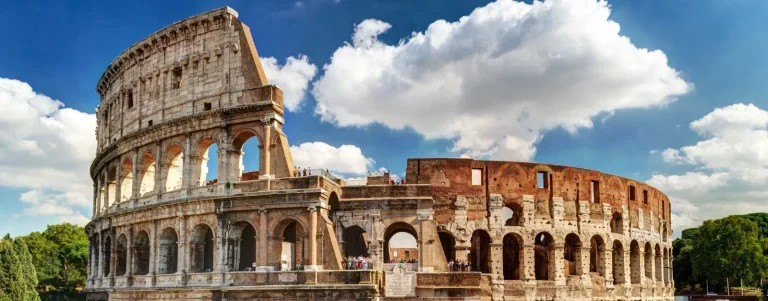
Rome’s most popular monument was built between 72-80 A.D. The Colosseum is still the largest amphitheater in the world, and stands as an iconic symbol of Rome and the great Roman architecture. The Colosseum was constructed as a gift to the Roman Citizens from the Flavian Dynasty to increase their popularity, to stage various forms of entertainment, and to showcase Roman engineering techniques to the world.
The real name of the colosseum is the “Flavian amphitheater”, named after the Flavian family line of Roman Emperors. It got the name Colosseum because of a statue that was located alongside the amphitheater called ‘the colossus of Nero’. In fact, the Roman Colosseum is always capitalized and spelled differently then the generic Coliseum.
About 60,000 Jewish slaves built the Colosseum in 9 years! Even today, construction of a stadium that size would be difficult to build in only 9 years. Colosseum is an elliptical building measuring 189 meters long and 156 meters wide with a base area of 24,000 m² with a height of more than 48 meter. More than 100,000 cubic meters of travertine stone were used for the outer wall of Colosseum which was set without mortar held together by 300 tons of iron clamps.
About 50,000 people could enter it and it would only take about 20 minutes for everybody to find their seat, due to 84 gates. The Romans had the earliest form of a Sky dome. If it rained they stretched a red canvas over the entire Colosseum!
400,000 people lost their life and over a million wild animals were slaughtered festival and games could last up to a 100 days. During the inaugural games of the Colosseum in 80 CE held by Titus, some 9,000 wild animals were slaughtered. In 107 CE, Emperor Trajan is said to have celebrated his victories in Dacia with contests involving 11,000 animals and 10,000 gladiators within 123 days. The last gladiatorial fights occurred in 435 CE and the last animal hunts stopped in 523 CE. It was primarily due to the cost of procuring animals and gladiators and maintaining the expensive facility.
The ancient Romans sometimes fled the Colosseum. The wooden floor of the Colosseum was removed and the lower cells beneath would be filled with water for mock naval battles to take place. This kind of entertainment wasn’t quite as popular as the gladiator battles, so eventually it moved elsewhere and the wooden floor became permanent.
Entrance was free and food was given during the shows. The famous saying was “free bread and circus to the people of Rome”. During the middle age era a number of fruit trees grew up in the Colosseum and nobody understood why… It seems that people were either spitting out there seeds or throwing in their fruit. In fact, The Colosseum was a popular destination for botanists. As catalog began to be compiled of the the flora in 1643 and over 337 different species have taken root among the ruins.
Many natural disasters devastated the structure of the Colosseum, but it was the earthquakes of 847 AD and 1231 AD that caused most of the damage you see today as all of the southern side of the Colosseum collapsed that time and was restored later on.
In the early medieval era it was no longer used for entertainment purposes. Eventually the Colosseum was used for workshops, housing, a quarry, a fortress and even as a Christian shrine. The marble facade and some parts of the Colosseum were used in the construction of St. Peter’s Basilica in Vatican City and the Spanish Steps.
Ray Charles, Paul McCartney, Billy Joel and Elton John have all performed concerts at the Colloseum.
The Colosseum has become a symbol against capital punishment. The death penalty was abolished in Italy in 1948. Today, any time anyone in the world has their sentence of death commuted, the lights in the night time illumination of the Colosseum change from white to gold. This color change also occurs whenever a jurisdiction abolishes the death penalty.
10 Facts about Rome’s Piazza Venezia and the Vittoriano
February 9, 202412 min readRome sights & tips
Picture yourself standing in the heart of Rome, surrounded by the gentle splash of Baroque fountains, the vibrant chatter of artists at their easels, and the warm glow of afternoon sun illuminating centuries-old facades. This is Piazza Navona, one of Rome’s most enchanting public squares where Roman antiquity meets Baroque grandeur. Built atop an ancient stadium and adorned with masterpieces by legendary architects, piazza navona rome draws millions of visitors who come to experience its unique blend of history, art, and authentic Italian life. Discover the magic of Piazza Navona with a guided Rolling Rome tour.
What Is Piazza Navona?
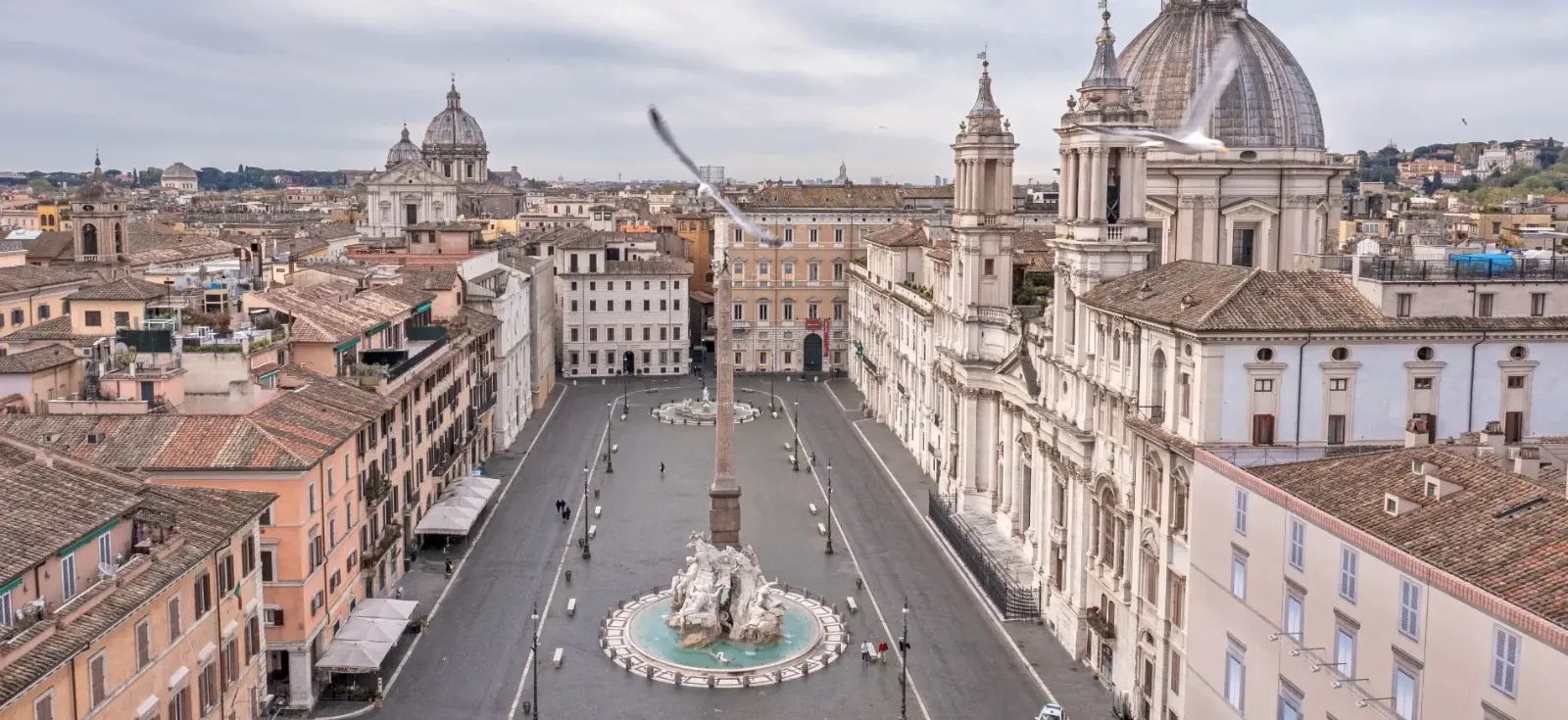
Piazza Navona stands as one of Rome’s most iconic public squares, occupying the exact footprint of the ancient Stadium of Domitian. Its distinctive elongated oval shape immediately reveals its athletic origins, while three magnificent fountains and surrounding Baroque palaces showcase centuries of artistic evolution. What began as a venue for Roman athletic competitions transformed into a vibrant civic space during the Renaissance and Baroque periods. Today, rome piazza navona pulses with life as sidewalk cafés, street performers, and visitors mingle beneath the watchful gaze of towering sculptures and ornate church domes, creating an atmosphere that seamlessly blends monumental history with everyday Roman culture.
When Was Piazza Navona Built?
The foundations of piazza navona history reach back to 86 CE, when Emperor Domitian commissioned a grand stadium for athletic contests and public spectacles. For centuries, the ancient structure served Romans seeking entertainment, with its massive stone tiers accommodating thousands of spectators. The square’s dramatic transformation occurred during the 17th century under the patronage of Pope Innocent X, who reimagined the space as a showcase of Baroque urban design. Between 1644 and 1655, renowned architects Gian Lorenzo Bernini and Francesco Borromini contributed their genius to the piazza, creating the stunning fountains and church facade that define its character today. This layering of Roman engineering beneath Baroque artistry makes piazza navona rome history exceptionally rich.
1. It Was Built on a Roman Stadium
The elongated oval shape of piazza navona rome perfectly mirrors the ancient Stadium of Domitian, which once hosted 30,000 spectators for athletic games, chariot races, and gladiatorial contests. Unlike the Colosseum’s amphitheater design, this stadium followed Greek traditions with a flat racing track surrounded by tiered seating.
Modern visitors can explore remarkable features of the ancient stadium:
Underground passages revealing sophisticated Roman engineering techniques
Preserved travertine blocks and archways visible at the Stadium of Domitian museum
Original dimensions maintained above ground: 275 meters long and 106 meters wide
Ancient foundations supporting modern buildings around the square’s perimeter
The rome piazza navona archaeological site demonstrates how Romans built structures meant to endure millennia, with the stadium’s layout still dictating the square’s instantly recognizable shape today.
2. Home to the Fountain of the Four Rivers
At the heart of piazza navona stands the magnificent Fontana dei Quattro Fiumi, Gian Lorenzo Bernini’s 1651 masterpiece commissioned by Pope Innocent X. Four powerful marble figures represent the world’s major rivers known at the time—the Nile (Africa), Ganges (Asia), Danube (Europe), and Río de la Plata (Americas)—symbolizing papal influence across continents.
River God
Continent
Distinctive Feature
Symbolic Meaning
Nile
Africa
Head covered with cloth
Unknown river source at the time
Ganges
Asia
Holds a long oar
Navigation and trade routes
Danube
Europe
Touches papal coat of arms
Church’s European power base
Río de la Plata
Americas
Arm raised defensively
New World discovery and conquest
An ancient Egyptian obelisk, originally from the Circus of Maxentius, rises 16.5 meters from the fountain’s rocky base, crowned with the Pamphili family dove. This theatrical composition exemplifies why is piazza navona famous worldwide, combining sculpture, architecture, water, and symbolism into a stunning Baroque statement.
3. A Rivalry Between Bernini and Borromini
One of the most enduring piazza navona facts involves the legendary rivalry between Baroque masters Bernini and Borromini. Popular legend claims that Bernini’s Río de la Plata statue raises its arm defensively, as if shielding itself from the “terrible” facade of Sant’Agnese in Agone, designed by his competitor Borromini. Similarly, the Nile supposedly covers its face in horror at the church’s architecture. While this makes a delightful story told by tour guides throughout rome piazza navona, it’s actually chronologically impossible—Bernini completed the fountain in 1651, two years before Borromini even began work on the church facade. Nevertheless, the tale persists because it captures the genuine professional tension between these two brilliant architects who defined piazza navona rom’s appearance.
4. It Was Once Flooded for Fun
During summer weekends throughout the 17th and 18th centuries, authorities deliberately flooded piazza navona rome by blocking the fountain drains, transforming the square into a shallow lake called “Lago di Piazza Navona.” Noble families rode through the water in decorated carriages while common Romans waded and splashed in the cooling pools, finding relief from Rome’s oppressive summer heat. Pope Innocent X inaugurated this tradition, which became a popular public spectacle combining entertainment and practical cooling. The practice continued until 1866, when public health concerns ended the custom. Historical engravings and paintings preserve images of this unique summer festival, offering fascinating glimpses into piazza navona history and revealing how Romans ingeniously adapted their monumental spaces for communal enjoyment.
5. The Church of Sant’Agnese in Agone
Dominating the western side of piazza navona roma, the Church of Sant’Agnese in Agone marks the site where Saint Agnes was martyred in 304 CE. According to tradition, the 13-year-old Christian was exposed naked in a stadium brothel but miraculously protected when her hair grew to cover her body. Pope Innocent X commissioned the church as a family chapel, with Francesco Borromini taking over design duties in 1653. The church’s concave facade creates a theatrical sense of movement, while its soaring dome reaches skyward between twin bell towers. Inside, visitors discover breathtaking frescoes, intricate marble work, and gilded decorations that exemplify Baroque religious art. The church remains an active parish, hosting regular masses for both rome piazza navona residents and pilgrims.
6. A Showcase of Papal Power
Pope Innocent X (Giovanni Battista Pamphilj) transformed piazza navona history into a monument celebrating his family’s prestige and the Catholic Church’s global reach. Between 1644 and 1655, he commissioned the square’s three fountains, renovated the family palace, and built Sant’Agnese as dynastic statements of power.
His ambitious urban renewal project included:
Fountain of the Four Rivers – Proclaimed papal influence across four continents through allegorical river gods
Egyptian Obelisk – Symbolized the Church’s triumph over ancient paganism
Palazzo Pamphilj Expansion – Demonstrated family wealth with a massive residential palace
Sant’Agnese in Agone – Created a family church commemorating a martyred saint
Fountain Renovations – Upgraded existing fountains to match the square’s new grandeur
His sister-in-law Olimpia Maidalchini wielded enormous influence over these projects, earning the nickname “La Papessa” (the female pope). This ambitious transformation demonstrated why is piazza navona famous as a Baroque masterpiece—it represented not just artistic achievement but calculated political theater, using piazza navona rome as a stage for displaying authority.
7. Palazzo Pamphilj Is Now the Brazilian Embassy
The imposing Palazzo Pamphilj, occupying the entire western side of piazza navona, served as the Pamphilj family residence and demonstration of their wealth and status. Pope Innocent X commissioned architect Girolamo Rainaldi to expand the existing structures into a unified palatial complex. Inside, visitors can still admire Pietro da Cortona’s spectacular ceiling frescoes depicting scenes from Virgil’s Aeneid, though access is limited since Brazil acquired the building as its embassy to Italy in 1920. The palace’s grand gallery stretches 27 meters and showcases Baroque decorative arts at their finest. This diplomatic function adds another layer to piazza navona rome italy, where ancient, Renaissance, Baroque, and modern purposes coexist within the same architectural spaces.
8. A Hub for Christmas Markets
Every December, piazza navona transforms into Rome’s most beloved Christmas celebration, hosting the traditional Mercato di Natale. Wooden stalls fill the square, offering handcrafted nativity figures, toys, sweets, roasted chestnuts, and seasonal treats while twinkling lights illuminate the fountains and surrounding buildings. The tradition dates back centuries, when toy sellers and craftsmen gathered to sell Christmas goods. Today’s market attracts both Romans maintaining family traditions and tourists experiencing authentic Italian holiday spirit. The aroma of mulled wine and caramelized nuts mingles with carolers’ songs as children ride vintage carousels. Visiting piazza navona rome during the holidays offers a magical experience where historical setting meets contemporary celebration, making it one of the season’s most atmospheric destinations in the Eternal City.
9. Still a Place of Street Artists and Performers
Unlike many historic monuments that exist as static museums, rome piazza navona remains a living, working public space where artists and performers continue centuries-old traditions. Portrait painters set up easels daily, offering quick charcoal sketches or elaborate caricatures to passersby, while musicians perform everything from classical compositions to contemporary pop. Living statues pose motionlessly in silver paint, magicians perform sleight-of-hand tricks, and vendors sell artwork and handmade jewelry. This vibrant street culture connects directly to the piazza’s original purpose as a gathering place for Romans of all classes. The artistic energy feels authentic rather than staged, as many performers are working artists earning their livelihood, creating an atmosphere that captures piazza navona in rome as a genuine piece of Roman daily life.
10. A Timeless Landmark for Locals and Tourists
Piazza navona embodies the rare quality of appealing equally to international visitors and Roman residents who claim it as their neighborhood square. Morning sees locals grabbing espresso at historic cafés, their conversations mixing with the splash of fountains. Afternoons bring sketching students, while evenings transform the space into an outdoor salon where couples stroll and families enjoy gelato beneath illuminated Baroque masterpieces.
The square’s enduring appeal lies in how seamlessly it blends monumental history with everyday pleasures—you can admire Bernini’s genius while savoring authentic Roman cuisine, or contemplate ancient ruins while watching children chase pigeons. This integration of past and present makes piazza navona rome italy an essential destination that rewards multiple visits. Experience the beauty of Piazza Navona with Rolling Rome’sexpert guides.
FAQ
Where is Piazza Navona located?
Piazza Navona sits in Rome’s historic center, specifically in the Rione Parione district. The square lies approximately 500 meters northwest of the Pantheon and a short walk from Campo de’ Fiori, along the Corso Vittorio Emanuele II. Its central location makes it easily accessible from most major Roman landmarks.
Why is Piazza Navona famous?
The square gained worldwide recognition for its extraordinary Baroque fountains, particularly Bernini’s Fountain of the Four Rivers, and its construction atop ancient Roman stadium ruins. The architectural rivalry between Bernini and Borromini, combined with the stunning Sant’Agnese church and vibrant street life, creates an unmatched cultural experience.
Can you visit the Stadium of Domitian under Piazza Navona?
Yes, the Stadium of Domitian Archaeological Area operates as an underground museum beneath the square’s northern end. Visitors descend to explore preserved sections of the ancient stadium, including archways, corridors, and seating areas, while multimedia displays explain Roman entertainment and the structure’s fascinating history.
Is Piazza Navona free to visit?
The square itself is completely free and accessible 24 hours daily, allowing visitors to walk through, admire the fountains, and enjoy the atmosphere without any entrance fee. Some nearby attractions, like the Stadium of Domitian museum, require tickets ranging from 8 to 10 euros.
What’s the best time to visit Piazza Navona?
Early morning offers peaceful views with soft lighting perfect for photography, while evening brings lively crowds and dramatically illuminated fountains creating romantic ambiance. December stands out as especially magical during the Christmas market, when festive decorations and holiday vendors transform the space into a winter wonderland.
Written by the Rolling Rome team Local guides sharing the stories of Rome since 2013.
Dominitian’s ancient stadium, in the heart of the city, is now adorned with fine Renaissance and Baroque buildings, designed by the most famous architects of the 16C and 17C. The breathtaking magnificence of the piazza was meant to show the authority of Pamphili family, who had their own palace facing the square. The piazza is one of Rome’s liveliest squares, full of tourists, portrait painters, vendors, musicians, mime artists , shops and restaurants.
1. One of Rome’s most beautiful squares
Piazza Navona is considered one of Rome’s most beautiful squares. It displays the genius of Bernini, Boromini and Giacomo della Porta with its three amazing fountains and a church. The fountain of the moor, the Fountain of Neptune and the eye catcher in the middle is the Fountain of the four rivers, which is considered Bernini’s masterpiece. Right across the middle fountain you can find yourself in front of the impressive Sant’ Agnese in Agone Church, designed by Boromini and dedicated to the young Christian virgin Agnese, who was executed at the site of the church, because of her beliefs.
2. Built on Domitian’s stadium
In 86 AD Domitian had a stadium built at the site of the square (Stadio di Domiziano). The stadium was used mostly for the athletic purposes, contests of wit and physical fitness. The stadium was a grand edifice, which had a rectangular shape with rounded short sides. It was completely covered in white marble and could seated up to 30,000 people. There are still remains beneath the square. The stadium was paved over in the 15th century and the Piazza Navona was created.
3. The Fountain of the Moor
The Fountain of the moor or the fontana del Moro, is located in the southern end of the square and takes its name from the group of figures representing an Ethiopian fighting with a dolphin. The work was sculptured in 1654 to a Bernini design. The masks and sculptures of the tritons are copies of the originals which can now be seen in the gardens of the Villa Borghese.
4. The Fountain of Neptune
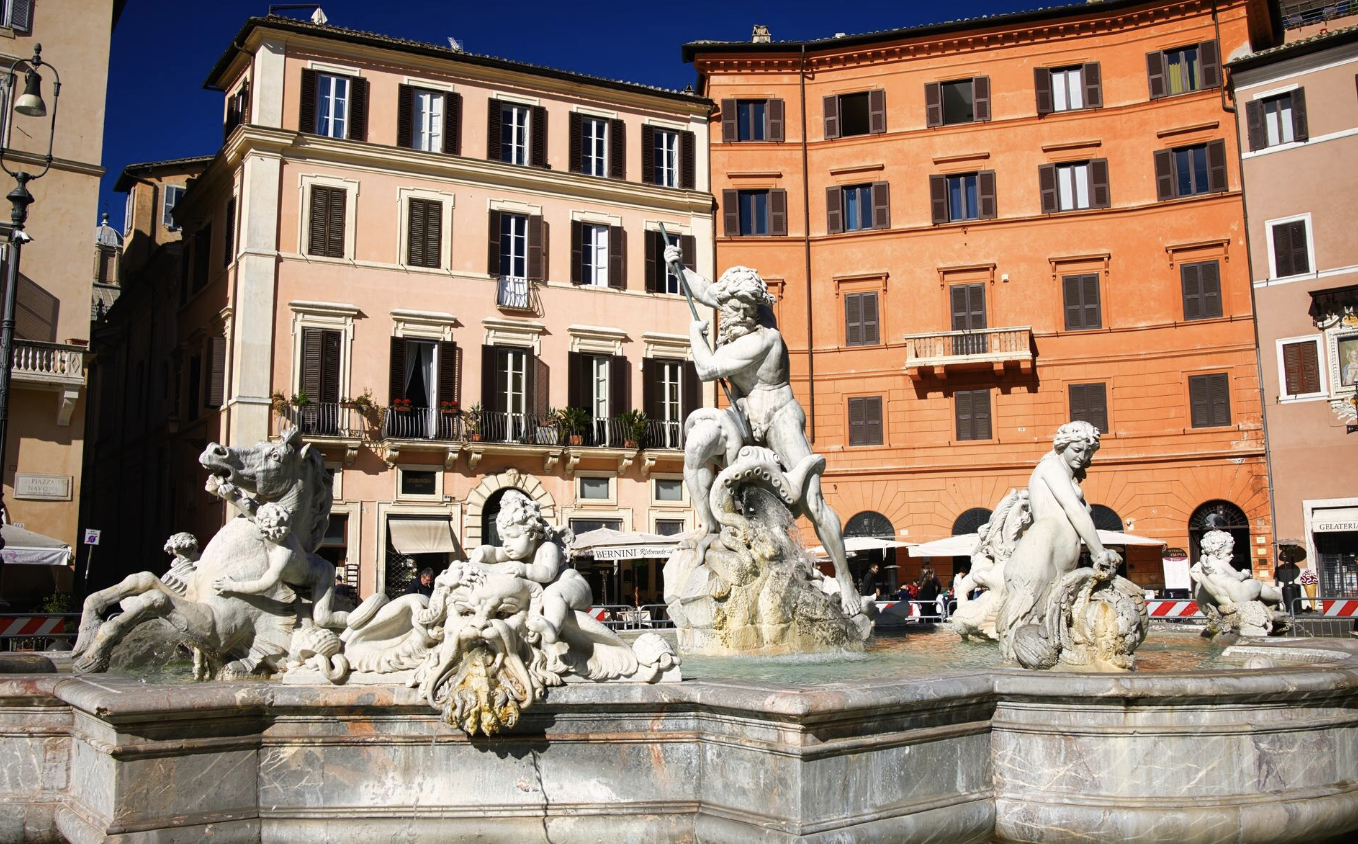
The Fountain of Neptune or Fontana del Nettuno , is located at the northern end of the piazza. This fountain was commissioned to Giacomo della Porta in 1574, and as with the Fontana del Moro on the southern end, the material used was Portasanta, which is a rose marble. Della Porta’s designed the two fountains to be similar in appearance, with tritons and large masks, but the project was never completed and for about 300 years the fountain remained undecorated. Finally in 1878, Antonio Della Bitta was commissioned to carve the statue of Neptune slaying a giant octopus, and Gregorio Zappala carved the group of 8 sea figures playing in the basin, two sea horses, two cherubs, two dolphins, and two Nereids or sea nymphs, and so the fountain was renamed, Fountain of Neptune.
Piazza Navona
ROME PIAZZA NAVONA
Piazza Navona
Facts about Piazza Navona
Piazza Navona
Facts about Piazza Navona
Piazza Navona
Facts about Piazza Navona
Piazza Navona
Facts about Piazza Navona
Piazza Navona
Facts about Piazza Navona
Piazza Navona
Facts about Piazza Navona
Piazza Navona
Facts about Piazza Navona
Piazza Navona
Facts about Piazza Navona
5. The Fountain of the Four Rivers
The Fountain of the four rivers or Fontana dei Quattro Fiumi, is the largest of the three fountains standing in piazza Navona. Constructed between 1647 and 1651, the design was first commissioned to Borromini, but was later taken over by Bernini. The fountain consists of four figures, each representing a river, from the four continent, known by those times- Nile (Africa), Ganges (China), Danube (Europe) and Rio della Plata (The Americas). The statues surround an obelisk with the Pamphili’s family symbol, a dove on the top. All three fountains in the Piazza Navona are fed by the Aqua Virgo aqueduct.
6. The obelisk in the centre
Erected in the middle of the square stands a gigantic Egyptian obelisk, which is actually a Roman copy, done during the reign of the emperor Domitian. With its impressive height it actually worried the people, concerned about the fountain’s stability.
7. The Bernini vs Borromini rivalry
Borromini vs. Bernini saga is legendary and described in many legends. The rumor has it that the positioned in the air hand of Rio della Plata is representing how ugly he thinks the church is and the hand on the chest of Sant Agnes is describing that she is scared from the obelisk to fall down, because is not supported good.
8. Where the name Navona comes from
The name of the stadium was ‘Circus Agonalis’ (competition arena). Over the time the name changed to ‘in agone’ to ‘navone’ and eventually to ‘navona’.
9. The “Lake of Piazza Navona”
Pope Innocent X started a tradition of covering the drains of the three fountains on Saturdays and Sundays in the 1600s, to allow people to enjoy the pooled water. It became known as “Lake of Piazza Navona”. This tradition lasted for two centuries until 1866 when Pius IX put an end to the summer fun.
10. A favourite film location
Piazza Navona is featured in scenes in the 2000 movie Angels and Demons, and in the 1964 movie Yesterday, Today and Tomorrow it is the setting of the main character’s apartment. It is also featured in the 1970 movie Catch-22, and in the 1990 movie Coins in the Fountain.
Written by the Rolling Rome team Local guides sharing the stories of Rome since 2013.
Imagine the dust-choked streets of Rome in 100 BC, where the clash of gladiatorial blades mingled with the whispers of senatorial plots, and legions marched under eagles that demanded unyielding loyalty. Gaius Julius Caesar emerged from this turbulent world as a masterful general, shrewd statesman, and prolific writer whose decisions reshaped an empire. This Julius Caesar biography reveals ten striking facts from his life, drawing on ancient accounts like Suetonius and Plutarch to illuminate the man behind the myths. Through his Julius Caesar story, readers gain insight into ambition’s price and legacy’s endurance.
Who Was Julius Caesar?
A towering figure of Roman history from about 100 BC to 44 BC was Gaius Julius Caesar, known to history simply as Julius Caesar. The patrician gens Julia gave him birth. With consummate skill he weathered the stormy tides of late republican politics. As a commanding general he presided over the legions, bound by a stronger tie than their own; by his command he spread the borders of Rome. As a statesman he initiated reforms which would make a failing system stable.
As an author his Commentarii de Bello Gallico was sent to the Senate directly from the battlefield. His summary of Julius Caesar recalls a life of incessant ascent, for he passed from avoiding the proscriptions of Sulla from the time of youth to the forming of the First Triumvirate with Pompey and Crassus in 60 BC. The conquests of Caesar in Gaul alone resulted, according to his own figures, in losses of over 1,000,000 enemies. This brought him great popularity among the vulgar multitude. But in 44 BC his dictatorship for life excited fears of monarchy, with the consequences of a violent death. This who was Julius Caesar? questions brings to light the fact that he was an architect of a real empire, whose who was Julius Caesar? status is attested to by coins, inscriptions and the testimony of living authorities such as Cicero. The Julius Caesar history of him is replete with the lessons of the double face of power.
When Was Julius Caesar Born and How Did He Rise?
When was Julius Caesar born? Records place his arrival on July 12 or 13, circa 100 BC, in Rome’s Subura district, amid the Republic’s factional strife. His father, a praetor, and mother, Aurelia, instilled patrician values, but early threats honed his resilience: at 18, Caesar defied dictator Sulla by refusing to divorce his wife Cornelia, fleeing into hiding until amnestied.
His ascent blended military prowess with political maneuvering. By 81 BC, he served as a cavalry officer in Asia; in 69 BC, as quaestor, he honored his late wife and aunt Julia in stirring eulogies that rallied the populares. Elected pontifex maximus in 63 BC through lavish bribery—spending beyond his means—Caesar built vital alliances.
Key milestones defined his Julius Caesar timeline:
59 BC: Elected consul, pushing land reforms for veterans.
58–50 BC: Proconsul of Gaul, subduing tribes and invading Britain twice.
60 BC: Formed the First Triumvirate with Pompey and Crassus.
49 BC: Crossed the Rubicon, igniting civil war and becoming dictator.
This Julius Caesar history arc, from priest to conqueror, spanned decades of calculated risks.
1. He Was Never an Emperor of Rome
Many confuse Julius Caesar with the later emperors of Rome. He never claimed that title, which was reserved for his successor Augustus. He had indeed a dictatorship and held it first for ten years in 46 B.C. and afterwards for life in 44 B.C., having almost absolute power without the insignia and pomp of emperors. The difference is important and shows one of the striking changes in his Julius Caesar history, namely, what was he in the dying breath of the Republic?
He had taken away the checks and balances and increased the Senate from 300 to 900 members, and conferred citizenship upon the Cisalpine Gauls, and brought them into subordinate relationship to the province. His reforms, therefore, gave rise to the empire. He had made the executive power supreme, made the tax system to furnish money for public works such as the Forum Julium and rectified the management of provincial government. He scorned the god-like honors which would come to kings in later years, though many son cults arose in post-mortem longevity. His Julius Caesar story, therefore, is a curious example of the irony of ambition, for by refusing the kingship by failing to accept a diadem offered him by Antony at the Lupercalia, he only increased the suspicion of tyrannical intentions. Suetonius, the ancient biographer, points out the clementia of Caesar, his forgiving of opponents, such as Brutus after Pharsalus, as a contrast to other kings’ extravagant lives. This fact shows the necessity for his assumption of the dignity of a bridge builder from republic to empire, influencing rulers for centuries. The legacy was a example of statesmanship of a high order, but tainted by its overreaching.
2. His Birthdate and Name Have Mysteries
Pinpointing Julius Caesar’s exact origins adds intrigue to any Julius Caesar biography. Tradition holds his birth on July 12 or 13, around 100 BC, via caesarean section—hence the term—though medical historians dismiss this as myth, given his mother’s survival. The year wavers between 102 and 100 BC, per Plutarch, amid sparse records from turbulent times.
His Julius Caesar real name, Gaius Julius Caesar (inscribed as GAIVS IVLIVS CAESAR on coins), reflects patrician roots tracing to Aeneas and Venus, a claim he amplified for legitimacy. The cognomen “Caesar” derived from caesaries (hair) or an elephant-slaying ancestor, evolving into titles like kaiser and tsar.
Early life shrouded in fog: orphaned young, he dodged Sulla’s hit list at 18, hiding in Sabine hills before military service in Cilicia. This Julius Caesar birthday enigma ties to broader uncertainties, like rumored epileptic fits—possibly mini-strokes—first noted by Suetonius, affecting four episodes during campaigns. Such vulnerabilities humanize the icon, revealing a man who masked frailties behind laurel wreaths to conceal thinning hair.
These mysteries fuel endless debate, blending fact with legend in the Julius Caesar story. They remind us history thrives on gaps, inviting scrutiny of sources like Cicero’s letters, which confirm his youthful oratory flair.
3. Conqueror of Gaul and Beyond
Julius Caesar’s Gallic Wars epitomize his genius, transforming a backwater province into Rome’s breadbasket. From 58 to 50 BC, he subdued tribes across modern France and Belgium, chronicling eight campaigns in De Bello Gallico that doubled Rome’s territory and swelled his coffers with 800 million sesterces in plunder.
This Julius Caesar summary highlights brutal efficiency: at Alesia in 52 BC, he besieged Vercingetorix’s 80,000 warriors with double fortifications, starving them into surrender after weeks— a tactical masterstroke involving 60,000 legionaries and auxiliaries. Gaul’s conquest claimed 1,192,000 lives, per Caesar’s tally, including civilians, boosting his populist image back home.
Campaign
Years
Key Outcome
Forces Involved
Gallic Wars
58–50 BC
Subdued 300+ tribes
50,000 Romans vs. 1M+ Gauls
Britain
55–54 BC
Tribute extracted
10,000 men, no annexation
Alesia
52 BC
Vercingetorix surrender
60,000 vs. 80,000 besieged
Beyond Gaul, he probed Britain in 55 and 54 BC with 10,000 men, landing near Dover despite tempests. These forays deterred northern threats, securing trade routes. What happened to Julius Caesar in these years? Immense wealth and loyalty from the Tenth Legion, which mutinied once but was shamed into service with a single speech.
His Julius Caesar biography paints a reformer too: Gaul’s integration brought roads, aqueducts, and Roman law, civilizing tribes while enriching elites. Critics like Cato decried genocide, but Caesar’s narrative framed it as defensive necessity. This era solidified his myth as invincible strategist.
4. The “Crossing the Rubicon” Moment
In January of 49 BC with his legions behind him, Julius Caesar stood on the shallow fording point of the Rubicon River, aware that one step meant his path was now treason. Disobeying Senate decrees to disband, he said: “Alea iacta est” — “the die is cast” — and, with the Thirteenth Legion, crossed the river that led to civil war and the breaking of the Republic.
This pivot in the timeline for Julius Caesar stemmed from senatorial intransigence: following Pompey’s Eastern triumphs, his rivals stripped Caesar of his command, fearful of his Gaul-honed power. A Crossing was forbidden by sacred law, like a general bringing an army into Italy itself was impossible. They took Ariminium in part marchings, then Corfinium for the most part 30,000 Pompeians capitulated without battle.
As it raged on: Caesar chased Pompey to Pharsalus in 48 BC help 45,000 defeated 22,000 in flanking moves, killing 15,000. What happened to Julius Caesar? One chase to Egypt, where Ptolemaic intrigue brought down Pompey, entangled him with Cleopatra. Back home in Rome, triumphs at Thapsus and Munda in 46-45 BC extinguished opposition.
In Part 2 of his Julius Caesar piece here, Keillor reveals the price of daring: clemency to enemies like Cicero held the republic together, but weakened its traditions. Suetonius tells of the symbolism of the Rubicon — once crossed, there is no retreat — and the same describes Caesar’s unalterable designs. This act created the dictatorship, which sealed Rome’s fate.
5. Reformer and Calendar Maker
Beyond battlefields, Julius Caesar wielded reform like a scalpel, modernizing a Republic teetering on chaos. Appointed dictator in 49 BC, he tackled debt by slashing interest rates 66% and redistributing 100,000 hectares of Campanian land to 80,000 veterans, easing urban poverty.
Central was the Julian calendar, introduced in 46 BC with Sosigenes of Alexandria. Replacing the erratic 355-day lunar system—prone to senatorial manipulation—it adopted a 365.25-day solar year, adding leap days every fourth February. This slashed seasonal drift by 11 minutes annually, serving until 1582 AD. Quintilis became July in his honor.
His Julius Caesar history includes urban renewal: the Forum Julium basilica, funded by Gallic spoils, housed legal proceedings; he drained marshes for farmland, boosting grain output 20%. Politically, he colonized provinces with 100,000 settlers, curbing unrest.
These Julius Caesar facts underscore expertise: unlike predecessors, Caesar consulted astronomers, ensuring longevity. Plutarch praises his efficiency, noting 23 laws in one day. Yet, reforms alienated optimates, viewing them as power grabs. His legacy? Practical governance that outlasted his life.
6. Famous for His Quotes—And One Turned Into A Legendary Saying
Julius Caesar’s eloquence rivaled his sword arm, producing quips that punctuate history and stage. His dispatches brim with precision: after Zela in 47 BC, he wired the Senate “Veni, vidi, vici”—I came, I saw, I conquered—capturing a 20,000-strong Pontic rout in five days.
Shakespeare amplified others: “Et tu, Brute?” at his stabbing, though Suetonius claims Greek “Kai su, teknon?”—you too, child?—to Brutus. These Julius Caesar quotes reveal a wit tempered by stoicism. To a doubting soldier: “Why, you want to know? To sup with me in triumph!” before Pharsalus.
His name’s evolution fascinates: “Caesar” birthed kaiser (German) and tsar (Slavic), denoting 30+ rulers, from Charlemagne to Nicholas II. This who was Julius Caesar? facet shows cultural osmosis.
Caesar authored prolifically: seven books on Gaul, three on civil war, plus speeches and poems praising ancestors. His style—terse, third-person—served propaganda, yet endures for clarity. These Julius Caesar fun facts highlight a polymath whose words, like deeds, conquered time.
7. His Assassination on the Ides of March
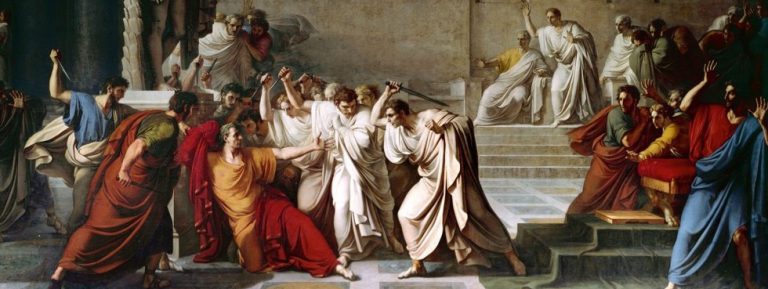
On March 15, 44 BC—the Ides of March—Julius Caesar entered Pompey’s Theatre for a Senate session, unaware of the blades awaiting. Over 60 conspirators, led by Brutus and Cassius, struck in a frenzy: 23 wounds felled him at Statilius’s base, blood pooling as he gasped.
How did Julius Caesar die? Fears of monarchy drove it: his perpetual dictatorship, refusal of bodyguards, and cultish honors evoked kingship, banned since Tarquin. Brutus, pardoned post-Pharsalus, joined for “liberty,” per Cicero’s later barbs.
The plot unraveled fast: Antony’s funeral oration incited riots, burning the conspirators’ homes. What happened to Julius Caesar’s killers? Defeated at Philippi in 42 BC, most suicided—Brutus on his sword, Cassius prematurely.
This Julius Caesar history turning point birthed the Second Triumvirate: Octavian, Antony, Lepidus avenged him, proscribing 300 senators, 2,000 equites. Caesar’s will bequeathed 75 denarii per citizen and gardens to the public, fueling deification. Suetonius details omens ignored—a dream of Calpurnia, severed horse hand. His death, not end, ignited imperial Rome.
8. He Left a Legacy — Including His “Son” and Successor
Adopted and natural successors would guide Rome’s fate too and the lineage of Julius Cesar would similarly permeate through the ages. His sole legitimate offspring, Julia, married Pompey in 59 BC, sealing the Triumvirate until her death in childbirth in 54 BC weakened the pact.
Main heir: Octavian, grandnephew adopted in the will of Caesar in 45 BC, styling himself Augustus in 27 BC as first emperor. Educated in the Egyptian campaigns, Octavian took his revenge, gathering 700 ships at Actium in 31 BC to defeat Antony.
Followed by: Caesarion, son born 47 BC to Cleopatra VII, announced co-ruler as Ptolemy XV, a Roman-Egyptian hybrid rule. Killed at 17 by Octavian in 30 BC to eliminate contenders, his being stoked propaganda of Caesar’s “eastern” designs.
The dynamic of this Julius Caesar son weaves personal drama with public legacy: His Julius Caesar bio chronicles liaisons with Servilia (Brutus mother) & others, simply generating rumors but no known bastards. His will provided for aqueducts and libraries, and his deification inspired imperial cult. Plutarch credits him with an extension of 400,000 km². His story? Dynastic theory for empire.
9. Details of His Physical Appearance and Personal Life
Togas are probably not the most flattering look for Julius Caesar and the ancient portrait busts that have survived offer a much more humanised quality. Suetonius wrote that he was tall with a fair complexion, keen black eyes, about 5’7″ (170 cm) according to skeletal estimates from busts,ountains shaped limbs, and a graceful neck. The height of Julius ceasar in Roman periods has always been a matter of envy, however, his hair early thinned onward-combing balds was covered by a laurel for concealment for baldness was also an april damp for among his foes.
He was fatally ill: four seizures were recorded (epileptic or migraines or hypoglycemia are suggested), one during an incident in 53 BC when working on a bridge-building exercise his aides hid him from view. He suffered malaria in Spain and concealed tremors with quick movements.
His personal life is in a continuing scandal – Three wives – Cornelia (mother of Julia), Pompeia (divorced over Clodius affair), Calpurnia – plus liaisons with Cleopatra from which he fathered Caesarion, and Mucia, in opposition to Pompey’s ire. An insatiable fan of Greek literature, he would dictate while on the road — at one point writing 30 letters a day —.
The following are some Julius Caesar fun facts about his flaws: Changing Tides predicts death in his nightmares , but he did. Busts show a face marked with lines, the hard grind of the 50s. His regime — cold baths, no midday naps — represented discipline, a curious amalgam of vigour and fragility in this intensely personal glimpse of Julius Caesar.
10. Why Julius Caesar Still Fascinates Today
Centuries on, Julius Caesar’s shadow looms large, from history texts to HBO series, captivating with raw ambition and tragic hubris. His Julius Caesar history influences language—”Caesar” as synonym for ruler, echoing in 18th-century Kaisers and Russian Tsars—and governance, with 2,000-year-old reforms like the Julian calendar ticking in our pockets.
Who was Julius Caesar to modern eyes? A blueprint for strongmen, studied in West Point tactics for Alesia’s encirclement, or dissected in Shakespeare for betrayal’s sting. His Julius Caesar biography inspires 500+ books yearly, per publisher logs, blending conquest’s thrill with dictatorship’s warnings—echoed in 20th-century caesars like Mussolini.
Tourists trace his steps: Forum ruins whisper of triumphs parading 4,000 captives. His story endures for embodying human scale—flawed genius who added 1 million square miles to Rome, only to fall by friends’ hands. Explore where Julius Caesar walked and ruled with a Rolling Rome guided tour.
FAQ
Who was Julius Caesar?
Gaius Julius Caesar was a Roman general, statesman, and author whose life from 100 to 44 BC transformed the Republic into an imperial foundation. He conquered Gaul, reformed governance, and authored key texts on his campaigns. His Julius Caesar biography captures a figure of unmatched influence, blending military might with political savvy.
How did Julius Caesar die?
Assassinated on the Ides of March, 15 March 44 BC, Julius Caesar fell to 23 dagger strikes from senators fearing his dictatorial power. Led by Brutus and Cassius in Pompey’s Theatre, the plot aimed to restore republican liberty but sparked further civil wars. How did Julius Caesar die? marks history’s ironic pivot.
Was Julius Caesar real?
Yes, Julius Caesar was a real historical figure, corroborated by his own writings, Cicero’s letters, and inscriptions like the Fasti Capitolini. Coins bearing his likeness from 44 BC and battlefield sites in Gaul affirm his existence. Was Julius Caesar real? doubts dissolve under contemporary evidence.
When was Julius Caesar born?
Julius Caesar was born on 12 or 13 July around 100 BC in Rome, into the patrician Julia clan. Slight discrepancies in ancient sources like Plutarch persist, but this date anchors his Julius Caesar timeline. When was Julius Caesar born? aligns with Republic’s final turbulent years.
What is Julius Caesar famous for?
Julius Caesar is famous for Gallic conquests adding vast territories, crossing the Rubicon to spark civil war, and reforms like the Julian calendar. His assassination and adoption of Octavian shaped empire. Julius Caesar history and fun facts highlight his enduring symbolic rulership.
Additional facts about Julius Caesar:
Julius Caesar is one of the most famous political and military leaders in the history of Ancient Rome. His achievements are not limited to conquests: his reform of the calendar system and changes to Roman law had a profound impact on the future of the Roman Empire. Caesar was also known for his political struggles, including with Pompey and Crassus, which led to his becoming dictator. His death marked the beginning of an era of significant change that ultimately led to the fall of the Roman Republic and the establishment of the Roman Empire.
For more information on the life and work of Julius Caesar, please refer to additional sources such as Britannica.
Written by the Rolling Rome team Local guides sharing the stories of Rome since 2013.
You are currently viewing a placeholder content from hCaptcha. To access the actual content, click the button below. Please note that doing so will share data with third-party providers.
You are currently viewing a placeholder content from Turnstile. To access the actual content, click the button below. Please note that doing so will share data with third-party providers.


 Written by the Rolling Rome team